Practical Guides
FRCitroën C3, C4, Berlingo: What Does the Roadworthiness Test Show?
Published 4 November 2026 · 5 min read
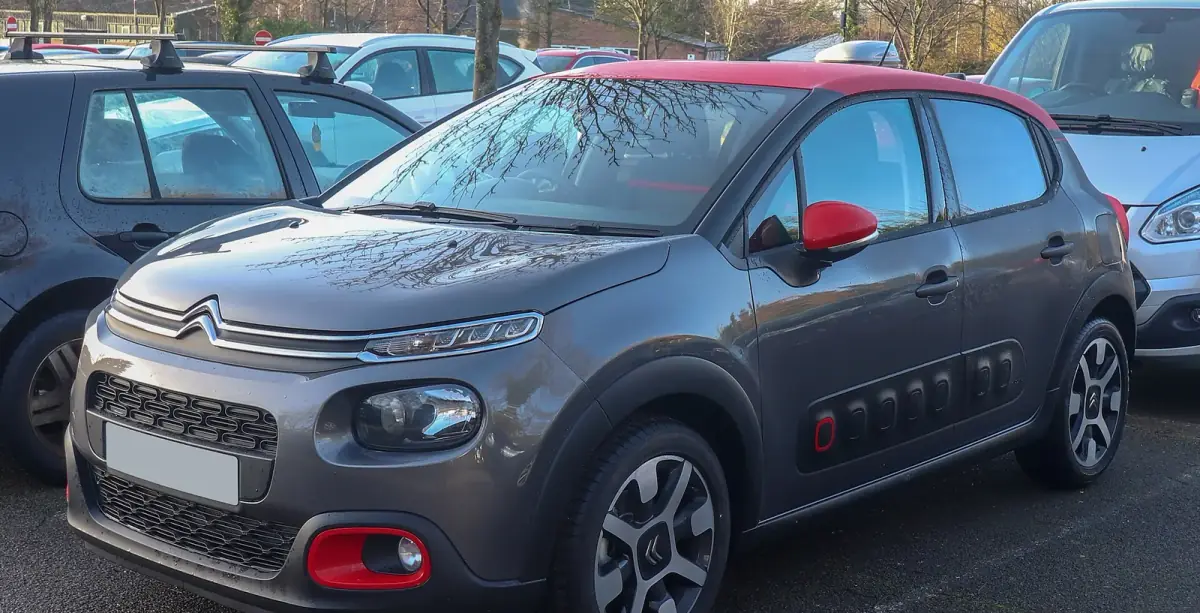
C3, C4, C4 Picasso, Berlingo, C1, C5: Citroën is one of the most common brands on the French used-car market. With 38 families tracked on this site, it also has one of the widest ranges in our data. Which Citroëns stand out at the roadworthiness test, and which do less well? Here’s what the official UTAC-OTC data from France’s roadworthiness test shows.
Citroën against the other brands
Across the 38 Citroën families tracked (2,419,388 tests represented), the weighted average retest rate is 19.16%. That puts Citroën 18th out of 38 brands, 0.2 points from the national reference rate (18.94%, see the 2025 barometer).
| Brand | Retest rate | Rank (/38) |
|---|---|---|
| Dacia | 16.78% | 10 |
| DS | 18.40% | 13 |
| Citroën | 19.16% | 18 |
| Toyota | 20.92% | 22 |
| Volkswagen | 23.44% | 28 |
| Renault | 24.91% | 33 |
| Peugeot | 25.55% | 35 |
Citroën is therefore clearly ahead of Renault, Volkswagen and above all Peugeot (in French), despite belonging to the same group, with a gap of more than 6 points. The full brand ranking is on the rankings page (in French).
The gap with Peugeot comes first from the make-up of the ranges. Ten Citroën families have a rate below 10%; they account for 25.7% of Citroën tests, against 8.7% for the six Peugeot families in the same position. They include four high-volume older generations with an unusually low rate (C3 I, C4 Picasso I, Berlingo I, C5 I, see below). By our own calculation, without these four families the Citroën average would be 22.20%: still ahead of Renault and Peugeot, but much further from the national rate.
With comparable models, the gaps between Citroën and Peugeot go both ways:
| Segment | Citroën | Peugeot |
|---|---|---|
| Leisure activity vehicles (2nd generation) | Berlingo II: 30.01% | Partner II: 29.06% |
| Compact vans (2nd generation) | Jumpy II: 32.93% | Expert II: 32.62% |
| Compact vans (3rd generation) | Jumpy III: 24.52% | Expert III: 24.82% |
| Leisure activity vehicles (3rd generation) | Berlingo III: 17.84% | Partner III (Rifter): 6.85% |
| Family hatchbacks (2000s) | C4 I: 12.83% | 307: 31.55% |
| Compact SUVs | C5 Aircross I: 16.55% | 3008 II: 7.02% |
| Small SUVs | C3 Aircross I: 25.58% | 2008 I: 35.33% |
Where the two models are technical twins (Berlingo II and Partner II, Jumpy and Expert), the rates are almost identical, less than a point apart. Elsewhere, Citroën does better on some pairs (the C4 I against the 307, the C3 Aircross against the 2008 I) and worse on others (Berlingo III, C5 Aircross). One last example calls for caution: the C1 I (22.35%), the Peugeot 107 (37.02%) and the Toyota Aygo I (31.78%), three versions of the same city car, get very different rates. The 107 shows exactly the same rate as the 106, which suggests the source groups these two families together.
The Citroëns that stand out
The brand’s best rates, on volumes of more than 20,000 tests:
| Model | Retest rate | National rank (/530) | Tests |
|---|---|---|---|
| Berlingo I | 3.50% | 12 | 67,867 |
| DS4 | 5.40% | 33 | 30,272 |
| C5 I | 6.08% | 44 | 29,894 |
| C4 Picasso I | 6.33% | 52 | 140,353 |
| C3 I | 6.47% | 55 | 213,687 |
These results need careful reading. Four of these five families are older generations, and their rate is far lower than that of the following generation: Berlingo II at 30.01%, C4 Picasso II at 27.15%, C3 II at 27.90%, C5 II at 28.50%. That’s the opposite of the usual trend, where each new generation does better. The British data doesn’t point the same way for the C3 I either (see below). These figures are reproduced as published by the source, but we don’t present them as proof that these models are the safest Citroëns.
Among more recent Citroëns, five families are below the national rate: the C1 II (7.46%), the C4 Cactus (15.09%), the C5 Aircross I (16.55%), the C4 III (17.14%) and the Berlingo III (17.84%). Two caveats: the C1 II has exactly the same rate as the C2, and the C4 III the same as the C4 II. The source appears to group these families in pairs.
The C-Crosser shows 2.71%, the 4th lowest rate of the 530 families, but on only 4,552 tests: the sample is too small to draw any conclusion.
The Citroëns that do less well
| Model | Retest rate | National rank (/530) | Tests |
|---|---|---|---|
| Xsara Picasso | 33.89% | 480 | 95,567 |
| Xsara | 33.89% | 481 | 39,610 |
| Berlingo II | 30.01% | 408 | 73,867 |
| C5 II | 28.50% | 392 | 58,082 |
| C3 II | 27.90% | 380 | 231,956 |
| C4 Picasso II / C4 Spacetourer | 27.15% | 367 | 136,982 |
The Xsara and the Xsara Picasso have an identical rate, again probably because the source groups them. The C3 II and the C4 Picasso II carry a lot of weight: with 368,938 tests between them, they are among the most-tested Citroën families.
Two recent models are also above the national rate: the C3 Aircross I (25.58%, 345th) and the C3 III (22.41%, 283rd), the most-tested Citroën family (246,337 tests). How the C3 compares with its direct rivals is covered in our Clio, 208 or C3 comparison. In all, 20 of the 38 Citroën families are above the national rate. The Jumpy II (32.93%) is also among the brand’s highest rates, but on fewer than 7,000 tests.
Manufacturer recalls
RappelConso lists 90 separate notices concerning the Citroën families tracked on this site, published between 2018 and 2026. Counted using the method of our recall ranking by brand (a recall counts once per family it concerns), that makes 246 cumulative recalls across 27 of the 38 families. Citroën is 2nd in this ranking in raw terms, behind Peugeot (392), and 5th once adjusted for the number of models tracked (64.7 recalls per 10 models).
The most affected families are vans: the Jumpy III (37 notices) and the Jumpy II (27). They are followed by the C4 III (17), the C5 Aircross I (16) and the Berlingo III (15). Several notices cover a large part of the range at once: insufficient lubrication of the vacuum pump (2023, 11 families), the structure of the front airbag inflators (2024, 9 families, including the DS3, DS4 and DS5) and reduced strength of the camshaft chain (2025, 8 families). Seven of the 16 notices concerning the C5 Aircross I mention a fire risk (high-voltage battery, charging cable, fuel leaks).
85 of the 90 notices don’t specify the generation: they are attached to every possible generation of a model, which is why a 2025 notice also appears against the Berlingo I. A recall doesn’t mean a widespread defect, and it doesn’t show up in the retest rate.
The view from abroad
Only the three C3 generations are part of our correspondence table between countries, with high confidence. Measurement methods differ from one country to another (see comparing countries).
In the UK (MOT), Citroën fails 38.90% of the time and ranks 26th out of 29 makes, behind Peugeot (36.17%, 25th) but ahead of Renault (41.05%, 29th). The British data distinguishes between generations, and all three C3s there are above the average for their age band: C3 Mk3 at 22.32% against 20.54% at 5–8 years, C3 Mk2 at 46.43% against 38.66% at 11–15 years, C3 Mk1 at 49.38% against 40.80% for 15 years and over. The C3 I, the best-placed of the three in France, is therefore the worst-placed in the UK. The detail is on the Citroën in the UK page (in French).
In the Netherlands (APK), Citroën shows an average failure rate of 43.8% and ranks 65th out of 84 brands, behind Peugeot (42.6%, 59th) and Renault (41.7%, 53rd). This data is aggregated across all generations, and the result is inferred from the defects recorded. The C3 there is level with the average at 3–5 years (23.06% against 23.24%), then above it in every following age band, for example 30.14% against 26.51% at 5–8 years. See the Citroën in the Netherlands page (in French).
Abroad, then, Citroën ranks clearly lower than in France.
How much does a used Citroën cost?
| Model | Reference new price | Estimated used price |
|---|---|---|
| C3 III | €15,500 | ~€8,500 at 5 years, ~€6,410 at 8 years |
| C4 III | €24,000 | ~€15,550 at 3 years, ~€12,600 at 5 years |
| Berlingo III | €23,500 | ~€15,230 at 3 years, ~€11,100 at 6 years |
| C5 Aircross I | €31,550 | ~€20,440 at 3 years, ~€14,900 at 6 years |
This is an indicative estimate, not a valuation: it applies a typical depreciation curve by segment to each model’s reference new price. To compare the models within your budget, see the budget simulator (in French).
What these figures don’t tell you
The retest rate measures the safety points that are inspected, not overall mechanical reliability: an engine or gearbox failure doesn’t show up unless it affects an inspected point. The UTAC data doesn’t give the age of the vehicles tested either, and some families appear to be grouped at source, which limits fine-grained comparisons. See the methodology (in French).
Our take
At France’s roadworthiness test, Citroën sits mid-table, close to the national rate and clearly ahead of Peugeot, Renault and Volkswagen. But that average is partly carried by older generations with unusually low rates, which the British data doesn’t confirm. In both the UK and the Netherlands, the brand ranks in the bottom third. The best-placed recent Citroëns are the C4 Cactus, the C5 Aircross, the C4 III and the Berlingo III, all below the national rate. The C3 III and the C3 Aircross, both very common on the used market, are above it. As with other brands, the model and generation matter more than the badge. The model-by-model detail, including running costs, is on the Citroën brand page (in French).
Data sources: UTAC-OTC (French roadworthiness test, 2025), RappelConso (data.gouv.fr), DVSA MOT testing data (UK, Open Government Licence v3.0), RDW (Netherlands, CC0 licence). Full methodology on the methodology page (in French).
— Also worth reading
Practical Guides
Suzuki Swift, Vitara, Ignis: What Does the Roadworthiness Test Show?
What does the official UTAC-OTC data say about Suzukis? Retest rates by model, a comparison with other brands, recalls and the view from abroad.
15 November 2026 · 5 min read
Practical Guides
Nissan Micra, Juke, Qashqai: What Does the Roadworthiness Test Show?
What does the official UTAC-OTC data say about Nissans? Retest rates by model, a comparison with other brands, recalls and the view from abroad.
11 November 2026 · 5 min read
Practical Guides
Fiat 500, Panda, Punto: What Does the Roadworthiness Test Show?
What does the official UTAC-OTC data say about Fiats? Retest rates by model, a comparison with other brands, recalls and the view from abroad.
6 November 2026 · 5 min read