Practical Guides
FRNissan Micra, Juke, Qashqai: What Does the Roadworthiness Test Show?
Published 11 November 2026 · 5 min read
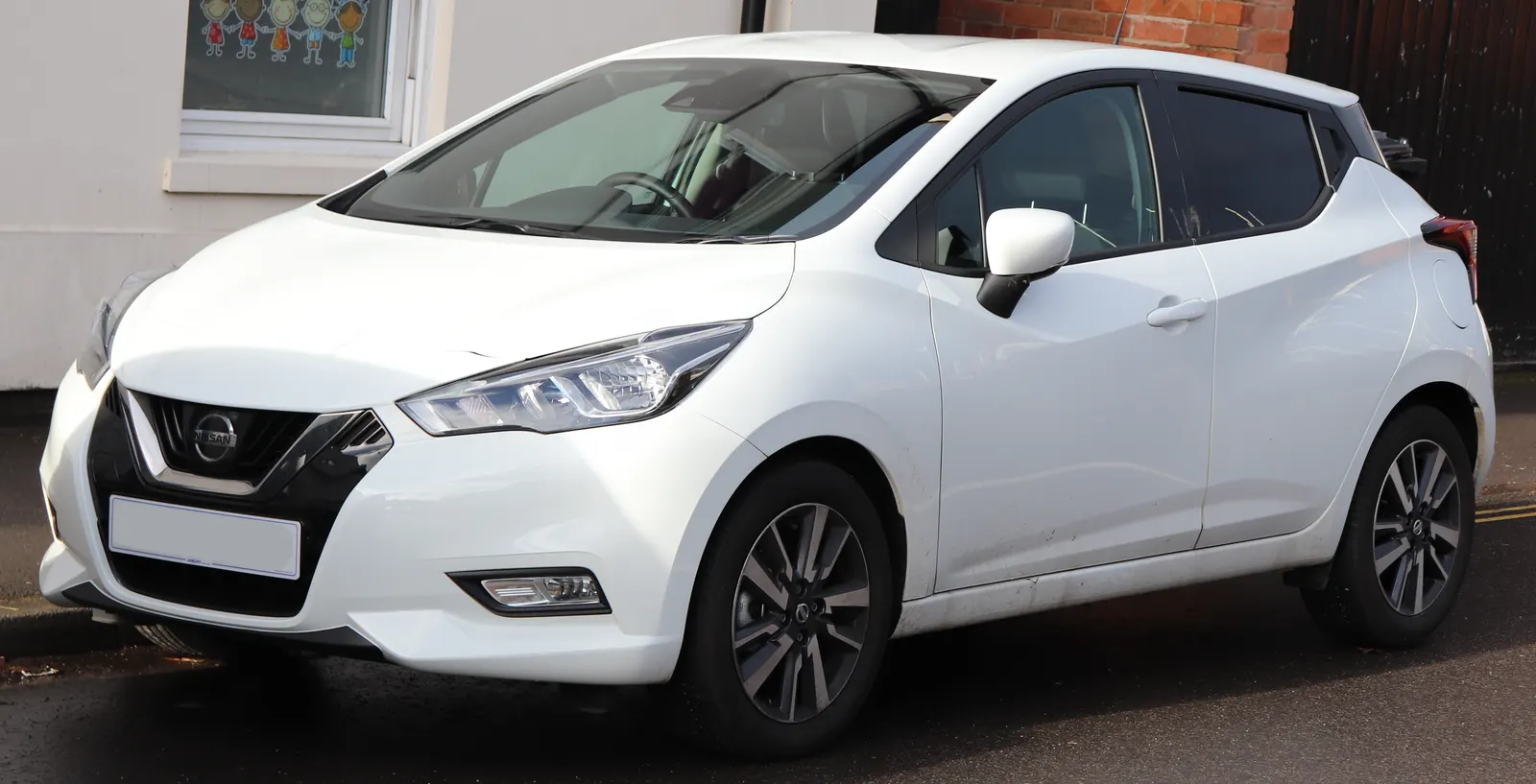
Micra, Note, Juke, Qashqai, X-Trail: Nissan is a common sight on the French used-car market, from small city cars to SUVs. How do these models fare at the roadworthiness test? Here’s what the official UTAC-OTC data from France’s roadworthiness test shows, model by model, across the 19 Nissan families tracked on this site.
Nissan against the other brands
Across the 19 Nissan families tracked (454,478 tests represented), the weighted average retest rate is 24.87%. That puts Nissan 32nd out of 38 brands, 5.9 points above the national reference rate (18.94%, see the 2025 barometer).
| Brand | Retest rate | Rank (/38) |
|---|---|---|
| Mazda | 13.81% | 4 |
| Dacia | 16.78% | 10 |
| Mitsubishi | 19.47% | 20 |
| Toyota | 20.92% | 22 |
| Ford | 23.17% | 27 |
| Suzuki | 23.68% | 31 |
| Nissan | 24.87% | 32 |
| Renault | 24.91% | 33 |
| Peugeot | 25.55% | 35 |
| Honda | 26.28% | 36 |
Nissan sits level with Renault, its partner in the industrial alliance (24.91%, 33rd), and does slightly better than Peugeot (in French). Among Japanese brands, it is behind Mazda, Toyota, Mitsubishi and Suzuki, and ahead of Honda. The full ranking is on the rankings page (in French).
The Qashqai weighs heavily in this average: its two generations account for 37% of Nissan tests, and the Juke I for 17% on its own. In all, 13 of the 19 families are above the national rate, and they make up 71.4% of the brand’s tests.
The Nissans that stand out
| Model | Retest rate | National rank (/530) | Tests |
|---|---|---|---|
| Qashqai II | 11.36% | 144 | 91,734 |
| Juke II | 18.16% | 231 | 12,054 |
| Micra V | 19.05% | 246 | 25,955 |
The Qashqai II is both the most-tested and the best-placed Nissan family: 7.6 points below the national rate. We compared it with its direct rivals in our article on compact SUVs. The Juke II does slightly better than the national rate, on a smaller volume. The Micra V is level with the national rate (+0.1 points).
Four low-volume families (fewer than 10,000 tests) are also below the national rate: the Pathfinder III (12.74%, 5,415 tests), the Note II (15.54%, 9,324 tests), the Leaf II (16.70%, 6,404 tests) and the Micra II (18.35%, 5,128 tests). The Leaf II, the only electric Nissan in our data, rests on too small a sample to say more. Above all, bear in mind that the roadworthiness test doesn’t assess the battery: this rate says nothing about the remaining range of a used Leaf.
The Nissans that do less well
| Model | Retest rate | National rank (/530) | Tests |
|---|---|---|---|
| Note I | 42.03% | 528 | 18,353 |
| X-Trail I | 33.14% | 473 | 11,201 |
| Juke I | 32.16% | 447 | 77,135 |
| Micra III | 31.44% | 426 | 32,450 |
| Qashqai I | 28.87% | 397 | 76,202 |
| X-Trail III | 27.97% | 382 | 22,571 |
| Micra IV | 26.84% | 365 | 29,296 |
The Note I has the third-highest retest rate of the 530 families tracked on this site. The Juke I and the Qashqai I, the two most-tested Nissan families after the Qashqai II, are well above the national rate (+13.2 and +9.9 points).
For each model, the recent generation does better than the previous one: the Qashqai goes from 28.87% to 11.36%, the Juke from 32.16% to 18.16%, the Note from 42.03% to 15.54%, and the Micra from 31.44% (III) to 26.84% (IV) and then 19.05% (V). Part of this gap probably comes down to the age of the vehicles, which the French data doesn’t specify. The X-Trail III does better than the two before it (33.14% and 31.20%), but remains 9 points above the national rate.
Three low-volume families complete the bottom of the table: the Pulsar VIII / Tiida III (32.05%, 7,074 tests), the X-Trail II (31.20%, 4,852 tests) and the Pixo (30.34%, 5,235 tests).
Manufacturer recalls
RappelConso lists 8 separate notices concerning the Nissan families tracked on this site, published between 2021 and 2026. Counted using the method of our recall ranking by brand (a recall counts once per family it concerns), that makes 25 cumulative recalls across 17 of the 19 families. Nissan is 19th in this ranking in raw terms, with 13.2 recalls per 10 models tracked, far behind Peugeot (392) or Renault (92).
These notices cover rear-door child locks that may not work (Juke, Note, Pulsar, Qashqai, 2021), the driver’s airbag (Juke, 2021), the passenger airbag (Patrol, Terrano, X-Trail, 2022), a fuel line at risk of leaking (Qashqai, 2025), and defects specific to electrified models (Leaf in 2021 and 2023, Micra and X-Trail in 2026). 6 of the 8 notices concern a risk of injury, 2 a fire risk.
None of the 8 notices specifies the generation: they are attached to every possible generation of a model, which is why a 2026 notice about a traction battery cell appears against every Micra, the Micra II included. A recall doesn’t mean a widespread defect, and it doesn’t show up in the retest rate.
The view from abroad
Only the Qashqai is part of our correspondence table between countries. For the other models, we refer to British generations by their own names without formally matching them to the French families. Measurement methods differ from one country to another (see comparing countries).
In the UK (MOT), Nissan fails 33.85% of the time and ranks 21st out of 29 makes, ahead of Ford (34.28%, 22nd), Peugeot (36.17%, 25th) and, above all, Renault (41.05%, 29th), but behind Toyota (29.30%, 17th) and Volkswagen (31.16%, 19th). The British data distinguishes between generations and ages, and confirms several of the French findings:
- the Qashqai J11 (Qashqai II) is below the average (19.29% against 20.54% at 5–8 years), the Qashqai J10 (Qashqai I) well above it (51.42% against 38.66% at 11–15 years);
- the 2010–2018 Juke, the second most-tested Nissan (259,751 tests), fails 38.62% of the time at 8–11 years, against an average of 29.85%;
- the 2006–2012 Note is above the average (42.73% against 38.66% at 11–15 years), the 2013–2017 one below it (25.54% against 29.85% at 8–11 years);
- the 2017–2023 Micra is level with the average (14.20% against 14.66% at 3–5 years), as is the 2010–2016 one (29.14% against 29.85% at 8–11 years).
Two results qualify the French picture: the 2019 Juke is above the average there (17.48% against 14.66% at 3–5 years), whereas the Juke II is below the national rate in France. The 2018–2024 Leaf is below the average there (11.03% against 14.66% at 3–5 years), on 17,926 tests. The detail is on the Nissan in the UK page (in French).
In the Netherlands (APK), Nissan shows an average failure rate of 42.4% and ranks 57th out of 84 brands, just behind Renault (41.7%, 53rd) and Toyota (41.4%, 49th), and ahead of Peugeot (42.6%, 59th), against a national rate of around 37.5%. This data is aggregated across all generations, and the result is inferred from the defects recorded. In their main age band, the Qashqai (33.50% against 32.18% at 8–11 years), the Juke (40.84% against 39.72% at 11–15 years) and the Micra (48.82% against 47.50% at 15 years and over) are slightly above the average, the Note slightly below it (46.41%). See the Nissan in the Netherlands page (in French).
How much does a used Nissan cost?
| Model | Reference new price | Estimated used price |
|---|---|---|
| Qashqai II | €25,000 (€21,490 to €33,000) | ~€16,200 at 3 years, ~€11,810 at 6 years, ~€7,748 at 10 years |
| Juke II | €27,000 | ~€17,496 at 3 years, ~€12,755 at 6 years |
| Micra V | €16,000 | ~€10,600 at 3 years, ~€7,988 at 6 years |
This is an indicative estimate, not a valuation: it applies a typical depreciation curve by segment to a reference new price. Only the Qashqai II has its own new price in our data; the Juke II and the Micra V use their segment’s default price, which is why a Juke II comes out more expensive than a Qashqai II of the same age. To compare the models within your budget, see the budget simulator (in French) and our guide to which reliable used car to buy by budget.
What these figures don’t tell you
The retest rate measures the safety points that are inspected, not overall mechanical reliability: an engine or gearbox failure doesn’t show up unless it affects an inspected point, and the condition of a traction battery isn’t assessed. The UTAC data doesn’t give the age of the vehicles tested: for France, we can’t say how much of the gap between generations comes down to age. Finally, several families rest on fewer than 10,000 tests, which limits fine-grained comparisons. See the methodology (in French).
Our take
At France’s roadworthiness test, Nissan ranks in the bottom quarter of brands, 5.9 points above the national rate, level with Renault. This result is mainly down to its oldest and most widespread generations: the Juke I, Qashqai I, Micra III and Note I are all well above the national rate. The recent generations do better, starting with the Qashqai II, well placed in both France and the UK. In the UK, Nissan ranks higher among brands than it does in France; in the Netherlands, its commonest models stay close to the average for their age band. For a used-car buyer, the generation matters more than the badge. The model-by-model detail, maintenance budget included, is on the Nissan brand page (in French).
Data sources: UTAC-OTC (French roadworthiness test, 2025), RappelConso (data.gouv.fr), DVSA MOT testing data (UK, Open Government Licence v3.0), RDW (Netherlands, CC0 licence). Methodology: methodology (in French).
— Also worth reading
Practical Guides
Suzuki Swift, Vitara, Ignis: What Does the Roadworthiness Test Show?
What does the official UTAC-OTC data say about Suzukis? Retest rates by model, a comparison with other brands, recalls and the view from abroad.
15 November 2026 · 5 min read
Practical Guides
Fiat 500, Panda, Punto: What Does the Roadworthiness Test Show?
What does the official UTAC-OTC data say about Fiats? Retest rates by model, a comparison with other brands, recalls and the view from abroad.
6 November 2026 · 5 min read
Practical Guides
Citroën C3, C4, Berlingo: What Does the Roadworthiness Test Show?
What does the official UTAC-OTC data say about Citroëns? Retest rates by model, a comparison with other brands, recalls and the view from abroad.
4 November 2026 · 5 min read